
Mei Mei Luo, VIOLIN
Mei Mei Luo is recognized as one of South Florida's finest violinists. She served as the Assistant Concertmaster of the Florida Philharmonic Orchestra and on its final concert served as Concertmaster.
Miss Luo is the founding First Violinist of the acclaimed Delray String Quartet, which since 2003 has performed wide-ranging repertoire every season throughout three south Florida counties. She has also been a regular member of the Palm Beach Chamber Music Festival since 2000.
As a soloist she has performed the Tchaikovsky, Mendelssohn and Bruch Violin Concertos. She is the Concertmaster of Orchestra Miami, The Boca Raton Symphonia, and the Opus One Orchestra (Miami City Ballet). During the 30th Anniversary Season of The Miami City Ballet she performed Samuel Barber's Violin Concerto, and in its 32nd season she and pianist Francisco Renno performed the Stravinsky Duo Concertant onstage with dancers.
Miss Luo earned her bachelor’s degree from the Shanghai and Shenyang Conservatory of Music. She was the second prize winner of the National Youth Violin Competition of China and is a graduate of the master's program at the University of Miami.
She has recorded the American Quartet by Dvorak with the Delray String Quartet on the Poinciana label, Kenneth Fuchs String Quartet No 5 on the American Classics label, and Richard Danielpour’s String Quartet Nos. 5, 6, and 7 on the Naxos label. Four of her CDs from the Palm Beach Chamber Music Festival appear on the Klavier and Harmonia Mundi labels.
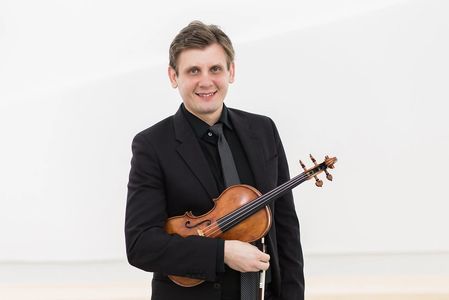
Valentin Mansurov, VIOLIN
First prize winner of the 14th National String Competition in the former U.S.S.R, has been engaged in worldwide solo and orchestral concerts in countries such as Spain, Germany, France, Greece, Canada, U.S. and Turkey.
Valentin began his violin studies as a seven year old at Uspenskiy’s School for Musically Gifted Children in Uzbekistan and studied at Bilkent University in Turkey, the National Conservatory for Music in Toulouse, France, Victoria Conservatory of Music in Canada and Mount Royal College.
In April 2002, Valentin received a degree representing performance excellence at the Annual Greater Victoria Festival.
Mr. Mansurov performs with and as a member of the Florida Grand Opera, Palm Beach Opera, Atlantic Classical Orchestra, and Henry Mancini Institute Orchestra.

Chauncey Patterson, VIOLA
Chauncey Patterson began his professional career at the age of 23 as Assistant Principal Viola of the Colorado Symphony. He was eventually appointed Principal Viola by Music Director Phillipe Entremont, and his next post was Principal Viola of the Buffalo Philharmonic under the direction of Seymon Bychkov. During his stay in Buffalo, Mr. Patterson was offered and accepted the Viola position in the award winning Miami String Quartet. Following his tenure with the MSQ, he served as interim violist of the world renowned Fine Arts Quartet. He currently resides in Miami, Florida, where he serves as Solo Viola of the Florida Grand Opera, Principal Viola of the Palm Beach Symphony, and Assistant Principal Viola of Miami’s ground breaking group Nu Deco Ensemble. He also serves as Assistant Principal Viola at the Eastern Music Festival in the summers and holds the same position with the All Star Orchestra under the baton of Maestro Gerard Schwarz.
Mr. Patterson’s faculty affiliations include: The Cleveland Institute of Music, Blossom School of Music, Kent State University, Hartt School of Music, Encore School for Strings, Eastern Music Festival, University of Charleston (W.V.), University of Denver, New World School of the Arts, Florida International University, and the University of Wisconsin at Milwaukee. He is currently Associate Professor / Head of Chamber at Lynn University Conservatory of Music.
Mr. Patterson attended the University of North Carolina at Chapel Hill, the Cleveland Institute of Music, and the Curtis Institute, where he studied with Ann Woodward, Robert Vernon, Karen Tuttle and Michael Tree respectively.

German Marcano, CELLO
A Venezuelan cellist with one of the most versatile careers in Latin American scene. He was principal cello with the Simón Bolívar Symphony Orchestra and has performed regularly as guest soloist and conductor with Venezuela’s main orchestras. With the Rios Reyna string quartet Marcano performed widely in Europe, US and Latin America, with distinguished guests such as the legendary “Amadeus Quartet”.
As a teacher Marcano held important posts at the Simón Bolívar Conservatory (El Sistema), the Emil Friedman School, the Simón Bolívar University, and the Mozarteum Center’s Music School, and has been guest professor and lecturer in Grand Valley State University and Andrews University (Michigan), San Diego Youth Orchestra (California), the University of Iowa, Louisiana State University, University of Wisconsin and the Madison Cello Institute. He has premiered works from renowned Latin American composers some of them composed specially for him.
Among his publications we can count editions of cello works by Venezuelan composers and "A catalog of Latin American works for cello”, recently launched online in partnership with the Sphinx Organization and CelloBello. His recording catalog include standard repertoire, pioneering albums of Venezuelan folk music, chamber music with the “Rios Reyna String Quartet” and orchestral albums with the “Simon Bolivar Symphony” under the late Eduardo Mata.
He currently teaches at Palm Beach Atlantic University, New World School of the Arts, Vivace Music Academy and Palm Beach Suzuki School in Florida and plays regularly cello solo and chamber music with “Music in Miami” series, FIU Concert Series among others.
Marcano has been invited to play as principal cello with the Palm Beach Symphony, Symphony of the Americas and South Florida Symphony. He holds a BMus degree from the University of Surrey, England, the Premier Prix diploma from the Guildhall School of Music in London, and Masters and DMA degree from the University of Wisconsin-Madison. He lives in Florida with violinist wife Amari and dancer daughter Laura and clarinetist son Raul.
Help Keep The Music Playing
Your support and contributions will enable us to keep performing beautiful music for our community for years to come. Tap DONATE NOW below to give via credit card or PayPal. Click here for other donation payment options.
